#include <IWPOCTCamera.h>
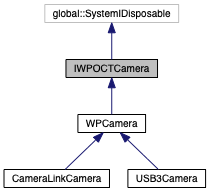
Public Types | |
| enum | ErrorCode { NoError = 0 , InitializeLibraryError = 1 , ShutdownLibraryError = 2 , UpdateCameraListError = 3 , GetCameraInfoError = 4 , OpenCameraError = 5 , CloseCameraError = 6 , MemoryAllocationError = 7 , ProcessingError = 8 , ReadParameterError = 9 , SetParameterError = 10 , StartAcquiringError = 11 , StopAcquiringError = 12 , GetBufferError = 13 , BufferCompletedWithZeros = 14 , AbortGetBufferError = 15 , RequeueBufferError = 16 , FlushBufferError = 17 , TimeoutError = 18 , CameraFileError = 19 , DongleNotFound = 20 , NumErrors = 21 , DLLExpired = 22 , NoError = 0 , InitializeLibraryError = 1 , ShutdownLibraryError = 2 , UpdateCameraListError = 3 , GetCameraInfoError = 4 , OpenCameraError = 5 , CloseCameraError = 6 , MemoryAllocationError = 7 , ProcessingError = 8 , ReadParameterError = 9 , SetParameterError = 10 , StartAcquiringError = 11 , StopAcquiringError = 12 , GetBufferError = 13 , BufferCompletedWithZeros = 14 , AbortGetBufferError = 15 , RequeueBufferError = 16 , FlushBufferError = 17 , TimeoutError = 18 , CameraFileError = 19 , DongleNotFound = 20 , NumErrors = 21 , DLLExpired = 22 } |
| The following are error codes that are used within the camera. More... | |
| enum | CameraType { NoCamera = 0 , USB3 = 1 , CameraLink = 2 , NI1433 = 3 , NumCameras = 4 , NoCamera = 0 , USB3 = 1 , CameraLink = 2 , NI1433 = 3 , NumCameras = 4 } |
| The following are the camera types that are used in GetOCTCamera and GetCameraType. More... | |
| enum | CurrentStates { Idle = 0 , LibraryInitialized = 1 , CameraOpened = 2 , ParametersSet = 4 , CameraAcquiring = 8 , Idle = 0 , LibraryInitialized = 1 , CameraOpened = 2 , ParametersSet = 4 , CameraAcquiring = 8 } |
| Current states of the camera (more than one can be active) The following are status codes that are used within the camera. More... | |
| enum class | ErrorCode { NoError = 0 , InitializeLibraryError = 1 , ShutdownLibraryError = 2 , UpdateCameraListError = 3 , GetCameraInfoError = 4 , OpenCameraError = 5 , CloseCameraError = 6 , MemoryAllocationError = 7 , ProcessingError = 8 , ReadParameterError = 9 , SetParameterError = 10 , StartAcquiringError = 11 , StopAcquiringError = 12 , GetBufferError = 13 , BufferCompletedWithZeros = 14 , AbortGetBufferError = 15 , RequeueBufferError = 16 , FlushBufferError = 17 , TimeoutError = 18 , CameraFileError = 19 , DongleNotFound = 20 , NumErrors = 21 , DLLExpired = 22 , NoError = 0 , InitializeLibraryError = 1 , ShutdownLibraryError = 2 , UpdateCameraListError = 3 , GetCameraInfoError = 4 , OpenCameraError = 5 , CloseCameraError = 6 , MemoryAllocationError = 7 , ProcessingError = 8 , ReadParameterError = 9 , SetParameterError = 10 , StartAcquiringError = 11 , StopAcquiringError = 12 , GetBufferError = 13 , BufferCompletedWithZeros = 14 , AbortGetBufferError = 15 , RequeueBufferError = 16 , FlushBufferError = 17 , TimeoutError = 18 , CameraFileError = 19 , DongleNotFound = 20 , NumErrors = 21 , DLLExpired = 22 } |
| enum class | CameraType { NoCamera = 0 , USB3 = 1 , CameraLink = 2 , NI1433 = 3 , NumCameras = 4 , NoCamera = 0 , USB3 = 1 , CameraLink = 2 , NI1433 = 3 , NumCameras = 4 } |
| enum class | CurrentStates { Idle = 0 , LibraryInitialized = 1 , CameraOpened = 2 , ParametersSet = 4 , CameraAcquiring = 8 , Idle = 0 , LibraryInitialized = 1 , CameraOpened = 2 , ParametersSet = 4 , CameraAcquiring = 8 } |
Public Member Functions | |
| virtual bool | IsInitialized () const =0 |
| Is the camera library initialized? | |
| virtual bool | IsOpened () const =0 |
| Is the camera opened? | |
| virtual bool | AreParametersSet () const =0 |
| Are camera parameters set? | |
| virtual bool | IsAcquiring () const =0 |
| Is the camera currently acquiring? | |
| virtual int | GetScanWidth () const =0 |
| Get the width of a scan (e.g. 2048) | |
| virtual int | GetScanHeight () const =0 |
| Get the height of a scan. | |
| virtual bool | GetScanWidthAndHeight (int *width, int *height) const =0 |
| Get the width and height of a scan. More... | |
| virtual int | GetCameraWidth () const =0 |
| Get the width of the camera in pixels. More... | |
| virtual int | GetNumCameras () const =0 |
| Get the number of cameras in system. | |
| virtual const char * | GetCameraID (int index)=0 |
| Get the camera ID string. More... | |
| virtual int | GetNumBuffers () const =0 |
| Get the number of image buffers. | |
| virtual int | GetLinesLost () const =0 |
| Get the number of lines lost in the last frame. More... | |
| virtual int | GetTriggersMissed () const =0 |
| Gets the triggers missed because it occurred before scanning for the current trigger finished. More... | |
| virtual float | GetLinePeriod () const =0 |
| Gets the time between the start of line scans in microseconds. More... | |
| virtual float | GetExposureTime () const =0 |
| Gets the time of the camera in microseconds. More... | |
| virtual int | GetTriggerMode () const =0 |
| Get the trigger mode (internal, external with auto exposure, or external with specified exposure). More... | |
| virtual int | GetCameraType () const =0 |
| Gets the camera type of the camera object, either CameraLink or e2v OctoPlus USB3 (National Instruments 1433 is not yet implemented). | |
| virtual int | GetNumBitsInPixel () const =0 |
| Gets the number of bits used in a pixel (typically 10, 12, or 16). More... | |
| virtual int | GetNumBytesInPixel () const =0 |
| Get the size of a padded pixel in bytes (typically 2). | |
| virtual int | GetAcquisitionTimeout () const =0 |
| Gets the acquisition timeout in milliseconds. More... | |
| virtual int | GetResourceIndex () const =0 |
| Gets the current resource index of the frame grabber (0 or 1). More... | |
| virtual const char * | GetCameraFileName () const =0 |
| Gets the name of the camera configuration file (CCF) file being used. More... | |
| virtual bool | SetScanHeight (int value)=0 |
| Sets the scan height size but the camera is not changed until SetParameters is called. More... | |
| virtual bool | SetNumBuffers (int value)=0 |
| Sets the number of buffers available to the camera for acquisition, but the camera is not changed until SetParameters is called. More... | |
| virtual bool | SetLinePeriod (float value)=0 |
| Sets the period between lines in microseconds. More... | |
| virtual bool | SetExposureTime (float value)=0 |
| Sets the exposure time in microseconds. More... | |
| virtual bool | SetTriggerMode (int value)=0 |
| Sets the trigger mode of the camera. More... | |
| virtual bool | SetCameraFileName (const char *name)=0 |
| Sets the name of the camera configuration (CCF) file. More... | |
| virtual bool | SetAcquisitionTimeout (int value)=0 |
| Sets the acquisition timeout in milliseconds. More... | |
| virtual bool | SetResourceIndex (int value)=0 |
| Sets the active resource index if the frame grabber supports it. More... | |
| virtual bool | InitializeLibrary ()=0 |
| Opens the camera library. More... | |
| virtual bool | ShutDownLibrary ()=0 |
| Shuts down the camera library. More... | |
| virtual bool | Open (const char *id)=0 |
| Opens the camera specified by the id. More... | |
| virtual bool | Open (int id)=0 |
| Opens the camera specified by the id. More... | |
| virtual bool | Close ()=0 |
| Closes the camera opened with the Open command. More... | |
| virtual bool | ReadParameter (unsigned int address, unsigned int *value) const =0 |
| Reads a parameter or register from the camera and returns the value in the value argument. More... | |
| virtual bool | WriteParameter (unsigned int address, unsigned int value)=0 |
| Writes a parameter or register to the camera with the value supplied. More... | |
| virtual bool | SetParameters ()=0 |
| Sets the height of the camera buffers and the number of buffers based on values entered with SetScanHeight and SetNumBuffers. More... | |
| virtual bool | SetParameters (int height, int numBuffers)=0 |
| Sets the height of the camera buffers and the number of buffers that the camera can use. More... | |
| virtual bool | StartAcquiring ()=0 |
| Starts the camera acquiring frames of data. More... | |
| virtual bool | StopAcquiring (bool flushBuffers)=0 |
| Stops the camera data acquisition. More... | |
| virtual bool | ResetDevice ()=0 |
| Resets the camera or frame grabber. More... | |
| virtual bool | GetBuffer (void **buffer)=0 |
| Gets a camera buffer and returns a void pointer to the buffer. More... | |
| virtual bool | GetBuffer2 (unsigned short **buffer)=0 |
| Gets a camera buffer and returns the pointer to the buffer. More... | |
| virtual bool | GetBufferCopy (unsigned short *buffer)=0 |
| Gets a camera buffer and copies it into the buffer supplied. More... | |
| virtual bool | GetBufferAndIndex (void **buffer, int **index, unsigned long *frameNumber)=0 |
| Gets a camera buffer and returns a void pointer to the buffer. More... | |
| virtual bool | GetBufferAndIndex2 (unsigned short **buffer, int **index, unsigned long *frameNumber)=0 |
| Gets a camera buffer and returns a void pointer to the buffer. More... | |
| virtual bool | AbortGetBuffer ()=0 |
| Cancel the GetBuffer call. More... | |
| virtual bool | RequeueBuffer ()=0 |
| Requeues the most recent camera buffer obtained so it can be used again. More... | |
| virtual bool | RequeueBuffer (int *bufferHandle)=0 |
| Requeues the camera buffer pointed to by the bufferHandle so it can be used again. More... | |
| virtual bool | FlushBuffers ()=0 |
| Flushes all camera buffers so they can be used by the camera for acquisition. More... | |
| virtual bool | AcquireFramesWriteToDisk (const char *baseFilePath, int numFrames, bool keepMemoryAllocated)=0 |
| Acquire consecutive image acquisitions to memory. More... | |
| virtual bool | AcquireWriteFramesToMemory (unsigned short **data, int numFrames)=0 |
| Write consecutive image acquisitions to memory supplied by the application. More... | |
| virtual bool | AcquireWriteFramesToMemory (unsigned short *data, int numFrames)=0 |
| Write consecutive image acquisitions to memory supplied by this DLL. More... | |
| virtual IWPOCTCamera::ErrorCode | GetLastError () const =0 |
| Gets the result of the most current operation. | |
| virtual IWPOCTCamera::CurrentStates | GetCurrentState () const =0 |
| Gets the current status of the camera. More... | |
| virtual void | Dispose () |
| virtual bool | IsInitialized () |
| virtual bool | IsOpened () |
| virtual bool | AreParametersSet () |
| virtual bool | IsAcquiring () |
| virtual int | GetScanWidth () |
| virtual int | GetScanHeight () |
| virtual bool | GetScanWidthAndHeight (ref int width, ref int height) |
| virtual int | GetCameraWidth () |
| virtual int | GetNumCameras () |
| virtual string | GetCameraID (int index) |
| virtual int | GetNumBuffers () |
| virtual int | GetLinesLost () |
| virtual int | GetTriggersMissed () |
| virtual float | GetLinePeriod () |
| virtual float | GetExposureTime () |
| virtual int | GetTriggerMode () |
| virtual int | GetCameraType () |
| virtual int | GetNumBitsInPixel () |
| virtual int | GetNumBytesInPixel () |
| virtual int | GetAcquisitionTimeout () |
| virtual int | GetResourceIndex () |
| virtual string | GetCameraFileName () |
| virtual bool | SetScanHeight (int value) |
| virtual bool | SetNumBuffers (int value) |
| virtual bool | SetLinePeriod (float value) |
| virtual bool | SetExposureTime (float value) |
| virtual bool | SetTriggerMode (int value) |
| virtual bool | SetCameraFileName (string name) |
| virtual bool | SetAcquisitionTimeout (int value) |
| virtual bool | SetResourceIndex (int value) |
| virtual bool | InitializeLibrary () |
| virtual bool | ShutDownLibrary () |
| virtual bool | Open (string id) |
| virtual bool | Open (int id) |
| virtual bool | Close () |
| virtual bool | ReadParameter (uint address, ref uint value) |
| virtual bool | WriteParameter (uint address, uint value) |
| virtual bool | SetParameters () |
| virtual bool | SetParameters (int height, int numBuffers) |
| virtual bool | StartAcquiring () |
| virtual bool | StopAcquiring (bool flushBuffers) |
| virtual bool | GetBuffer (ref global::System.IntPtr buffer) |
| virtual bool | GetBuffer2 (ref global::System.IntPtr buffer) |
| unsafe bool | GetBufferCopy (ushort[] buffer) |
| virtual bool | GetBufferAndIndex (ref global::System.IntPtr buffer, ref global::System.IntPtr index, ref ulong frameNumber) |
| virtual bool | GetBufferAndIndex2 (ref global::System.IntPtr buffer, ref global::System.IntPtr index, ref ulong frameNumber) |
| virtual bool | AbortGetBuffer () |
| virtual bool | RequeueBuffer () |
| virtual bool | RequeueBuffer (ref int bufferHandle) |
| virtual bool | FlushBuffers () |
| virtual bool | ResetDevice () |
| virtual bool | AcquireFramesWriteToDisk (string baseFilePath, int numFrames, bool keepMemoryAllocated) |
| unsafe bool | AcquireWriteFramesToMemory (ref global::System.IntPtr data, int numFrames) |
| unsafe bool | AcquireWriteFramesToMemory (ushort[] data, int numFrames) |
| virtual IWPOCTCamera.ErrorCode | GetLastError () |
| virtual IWPOCTCamera.CurrentStates | GetCurrentState () |
Static Public Member Functions | |
| static IWPOCTCamera | GetOCTCamera (IWPOCTCamera.CameraType cameraType) |
| static IWPOCTCamera.ErrorCode | GetLastAttemptError () |
| static bool | DestroyOCTCamera (IWPOCTCamera camera) |
| static bool | DestroyOCTCamera () |
Protected Attributes | |
| bool | swigCMemOwn |
Detailed Description
- Order of Operations (Single-threaded)
Initialize Library
  Get Num Cameras
  Get Camera ID
  Open Camera
    Set Parameters
    Start Acquiring
      Get Buffer <--------.
      Use buffer          |
      Requeue Buffer      |
             |            |
             '------------'
    Stop Acquiring
  Close Camera
Shutdown Library
- Order of Operations (Multi-threaded)
Initialize Library
  Get Num Cameras
  Get Camera ID
  Open Camera
    Set Parameters
    Start Acquiring
      Get Buffer and Index <---------.
      Use buffer                     |
      Requeue Buffer(bufferHandle)   |
             |                       |
             '-----------------------'
    Stop Acquiring
  Close Camera
Shutdown Library
- Get Commands
The Get commands return some piece of information about the camera object that called it. With few exceptions, the object’s state does not change when calling one of these commands. Some of the calls are geared toward certain cameras.
- Set Commands
The Set commands change the state of the camera object that the command acts on. These commands are used to set the number of buffers, the scan height, etc. Certain calls only work on certain cameras.
- Series Capture Commands
The series capture commands capture consecutive frames to memory, and then optionally store the frames on disk. This allows for very high speed acquisitions, but is limited by the amount of physical memory. The memory used can be supplied by the application or the WPOCT Acquisition DLL. Any writing to disk occurs after all the acquisition is complete. The camera should not already be acquiring data when any of these commands are invoked.
- Status Commands
The status APIs returns the current status of the camera. They can be used to check that the camera is working properly.
Member Enumeration Documentation
◆ CameraType
The following are the camera types that are used in GetOCTCamera and GetCameraType.
Note that the National Instruments card is not yet implemented.
◆ CurrentStates [1/2]
Current states of the camera (more than one can be active) The following are status codes that are used within the camera.
They are part of the CurrentStates enum, which can be employed by the application. One or more codes will be returned when calling GetCurrentStatus() (OR'd together).
| Enumerator | |
|---|---|
| Idle | Idle means the library is not initialized. |
◆ CurrentStates [2/2]
|
strong |
◆ ErrorCode
The following are error codes that are used within the camera.
They are part of the ErrorCodes enum, which can be employed by the user. One code will be returned when calling GetLastError().
Member Function Documentation
◆ AbortGetBuffer()
|
pure virtual |
◆ AcquireFramesWriteToDisk()
|
pure virtual |
Acquire consecutive image acquisitions to memory.
When finished, write the frames to disk.
- Parameters
-
baseFilePath[in] pointer to a the path and base name of the files that are to be written. numFrames[in] the number of camera buffers to be written. keepMemoryAllocated[in] a flag that determines if the memory allocated for the acquisitions will be kept after the files are written. Set to true if several of these captures are to be scheduled.
- Returns
- true on success
Implemented in WPCamera.
◆ AcquireWriteFramesToMemory() [1/2]
|
pure virtual |
Write consecutive image acquisitions to memory supplied by the application.
- Parameters
-
data[in] pointer which will point to the start of the data after the acquisitions have finished. numFrames[in] the number of camera buffers to be written. keepMemoryAllocated[in] a flag that determines if the memory allocated for the acquisitions will be kept after the files are written. Set to true if several of these captures are to be scheduled.
- Returns
- true on success
Implemented in WPCamera.
◆ AcquireWriteFramesToMemory() [2/2]
|
pure virtual |
Write consecutive image acquisitions to memory supplied by this DLL.
- Parameters
-
data[out] pointer to a pointer which will point to the start of the data after the acquisitions have finished. numFrames[in] the number of camera buffers to be written.
- Returns
- true on success
Implemented in WPCamera.
◆ Close()
|
pure virtual |
Closes the camera opened with the Open command.
This call should be made after the StopAcquiring API is called.
- Returns
- true if successful
Implemented in USB3Camera, and CameraLinkCamera.
◆ FlushBuffers()
|
pure virtual |
Flushes all camera buffers so they can be used by the camera for acquisition.
This call is only needed by USB cameras when acquiring is stopped. Alternatively, the flushBuffer flag can be set to true in StopAcquiring to get the same effect.
Often called after StopAcquiring is called.
- Returns
- true on success
Implemented in USB3Camera, and CameraLinkCamera.
◆ GetAcquisitionTimeout()
|
pure virtual |
Gets the acquisition timeout in milliseconds.
A value of 0 or less is infinite timeout.
Implemented in WPCamera.
◆ GetBuffer()
|
pure virtual |
Gets a camera buffer and returns a void pointer to the buffer.
This call will wait until a buffer is filled before returning. If the timeout period is reached before the buffer is filled, the call returns with a false return value.
- Parameters
-
buffer[out] pointer to a void pointer that holds the location of the start of the camera buffer.
- Returns
- true on success
Implemented in USB3Camera, and CameraLinkCamera.
◆ GetBuffer2()
|
pure virtual |
Gets a camera buffer and returns the pointer to the buffer.
This call will wait until a buffer is filled before returning. If the timeout period is reached before the buffer is filled, the call returns with a false return value.
- Parameters
-
buffer[out] pointer to an unsigned short pointer that holds the location of the start of the camera buffer.
- Note
- Use this if the app is single-threaded.
- Returns
- true on success
Implemented in USB3Camera, and CameraLinkCamera.
◆ GetBufferAndIndex()
|
pure virtual |
Gets a camera buffer and returns a void pointer to the buffer.
The index associated with the buffer is also returned. This index is used with USB cameras to requeue the buffer specified. The frameNumber is a number that counts up as successive frames are returned. It can be used to assure the frames are put in the correct order. GetBufferAndIndex will wait until a buffer is filled before returning. If the timeout period is reached before the buffer is filled, the call returns with a false return value.
The frame number allows correct reassembling of frames as it counts up from 0.
- Note
- Use this when multi-threading.
- Parameters
-
buffer[out] pointer to a void pointer that holds the location of the start of the camera buffer. index[out] pointer to an int pointer that holds the index of the camera buffer. frameNumber[out] pointer to the frame number returned. This value counts up from zero when acquistion is started.
- Returns
- true on success
Implemented in USB3Camera, and CameraLinkCamera.
◆ GetBufferAndIndex2()
|
pure virtual |
Gets a camera buffer and returns a void pointer to the buffer.
The index associated with the buffer is also returned. This index is used with USB cameras to requeue the buffer specified. The frameNumber is a number that counts up as successive frames are returned. It can be used to assure the frames are put in the correct order. GetBufferAndIndex will wait until a buffer is filled before returning. If the timeout period is reached before the buffer is filled, the call returns with a false return value.
- Parameters
-
buffer[out] pointer to an unsigned short pointer that holds the location of the start of the camera buffer. index[out] pointer to an int pointer that holds the index of the camera buffer. frameNumber[out] pointer to the frame number returned. This value counts up from zero when acquisition is started.
- Returns
- true on success
Implemented in USB3Camera, and CameraLinkCamera.
◆ GetBufferCopy()
|
pure virtual |
Gets a camera buffer and copies it into the buffer supplied.
This call will wait until a buffer is filled before returning. If the timeout period is reached before the buffer is filled, the call returns with a false return value. Note that the RequeueBuffer API does not need to be called after calling this API.
- Parameters
-
buffer[out] void pointer to a buffer that will have the camera buffer data copied to it.
- Returns
- true on success
Implemented in USB3Camera, and CameraLinkCamera.
◆ GetCameraFileName()
|
pure virtual |
Gets the name of the camera configuration file (CCF) file being used.
This file is only used by CameraLink frame grabbers.
Implemented in WPCamera.
◆ GetCameraID()
|
pure virtual |
Get the camera ID string.
- Parameters
-
index[in] the camera or frame grabber index to get the name of.
Since the indices are zero-based, this number should be less than the value obtained with GetNumCameras().
- Returns
- an array of characters that represents the name of the camera or frame grabber
Implemented in USB3Camera, and CameraLinkCamera.
◆ GetCameraWidth()
|
pure virtual |
Get the width of the camera in pixels.
- See also
- GetScanWidth()
Implemented in USB3Camera, and CameraLinkCamera.
◆ GetCurrentState()
|
pure virtual |
Gets the current status of the camera.
- Note
- More than one can be active at the same time.
Implemented in WPCamera.
◆ GetExposureTime()
|
pure virtual |
Gets the time of the camera in microseconds.
- Note
- This call is only valid for USB3 cameras
Implemented in USB3Camera, and CameraLinkCamera.
◆ GetLinePeriod()
|
pure virtual |
Gets the time between the start of line scans in microseconds.
- Note
- This call is only valid for USB3 cameras using internal triggering.
- Returns
- line period in microseconds
Implemented in USB3Camera, and CameraLinkCamera.
◆ GetLinesLost()
|
pure virtual |
Get the number of lines lost in the last frame.
- Note
- This call is only valid for USB3 cameras
Implemented in WPCamera.
◆ GetNumBitsInPixel()
|
pure virtual |
Gets the number of bits used in a pixel (typically 10, 12, or 16).
To get the actual number of bits per pixel, this API should be called after the camera starts acquiring.
Implemented in USB3Camera, and CameraLinkCamera.
◆ GetResourceIndex()
|
pure virtual |
Gets the current resource index of the frame grabber (0 or 1).
This is used by frame grabbers that support more than one camera, such as the MX4. For other cards and for USB cameras, this call returns 0.
Implemented in WPCamera.
◆ GetScanWidthAndHeight()
|
pure virtual |
Get the width and height of a scan.
- Parameters
-
width[out] pointer to output bucket height[out] pointer to output bucket
- Returns
- true if both params set.
Implemented in WPCamera.
◆ GetTriggerMode()
|
pure virtual |
Get the trigger mode (internal, external with auto exposure, or external with specified exposure).
For USB cameras, this a value between 0 and 7.
- Note
- This call is only valid for USB3 cameras
Implemented in USB3Camera, and CameraLinkCamera.
◆ GetTriggersMissed()
|
pure virtual |
Gets the triggers missed because it occurred before scanning for the current trigger finished.
- Note
- This call is only valid for USB3 cameras
Implemented in WPCamera.
◆ InitializeLibrary()
|
pure virtual |
Opens the camera library.
This is the first step that must be taken to acquire camera line scan data.
- Returns
- true if successful
Implemented in USB3Camera, and CameraLinkCamera.
◆ Open() [1/2]
|
pure virtual |
Opens the camera specified by the id.
The camera id is obtained by a call to GetCameraID.
- Parameters
-
id[in] array of characters that contains the name of the camera or frame grabber (uses the camera's S/N or server name)
- Returns
- true if successful
Implemented in USB3Camera, and CameraLinkCamera.
◆ Open() [2/2]
|
pure virtual |
Opens the camera specified by the id.
The camera id can only be zero in single camera setups. It can be 0 or 1 in dual camera setups.
- Note
- This call is only valid for USB cameras.
- Parameters
-
id[in] int with a value of 0 or 1.
- Returns
- true if successful
Implemented in USB3Camera, and CameraLinkCamera.
◆ ReadParameter()
|
pure virtual |
Reads a parameter or register from the camera and returns the value in the value argument.
- Note
- This call is only valid for USB cameras.
- Parameters
-
address[in] the location where the parameter is stored.
value[out] pointer to int that contains the value of the register once the call returns.
- See also
- manual "UMA_OCTOPLUS-USB3_Mono_RevB5.pdf" for more information.
- Returns
- true if successful
Implemented in USB3Camera, and CameraLinkCamera.
◆ RequeueBuffer() [1/2]
|
pure virtual |
Requeues the most recent camera buffer obtained so it can be used again.
This call is used for USB cameras where only a single thread is used to acquire camera data. CameraLink frame grabbers do not need to call this API. Used with GetBuffer().
- Returns
- true on success
Implemented in USB3Camera, and CameraLinkCamera.
◆ RequeueBuffer() [2/2]
|
pure virtual |
Requeues the camera buffer pointed to by the bufferHandle so it can be used again.
This call is used for USB cameras where multi-threading is used to acquire camera data. CameraLink frame grabbers do not need to call this API. Used with GetBufferAndIndex().
- Parameters
-
bufferHandle[in] the buffer handle obtained in the GetBufferAndIndex call.
- Returns
- true on success
Implemented in USB3Camera, and CameraLinkCamera.
◆ ResetDevice()
|
pure virtual |
Resets the camera or frame grabber.
- Returns
- true on success
Implemented in USB3Camera, and CameraLinkCamera.
◆ SetAcquisitionTimeout()
|
pure virtual |
Sets the acquisition timeout in milliseconds.
The default timeout is 2000 milliseconds. A value of 0 or less signifies no timeout.
- Parameters
-
value[in] the timeout value in milliseconds.
- Returns
- true if successful
Implemented in WPCamera.
◆ SetCameraFileName()
|
pure virtual |
Sets the name of the camera configuration (CCF) file.
This is only used by CameraLink frame grabbers to set the camera width and scan height, along with many other camera parameters.
- Parameters
-
name[in] the fully qualified name of the camera file.
- Returns
- true if successful
Implemented in WPCamera, and CameraLinkCamera.
◆ SetExposureTime()
|
pure virtual |
Sets the exposure time in microseconds.
- Note
- This call is only valid for USB3 cameras.
- Parameters
-
value[in] the exposure time in microseconds.
- Returns
- true if successful
Implemented in USB3Camera, and CameraLinkCamera.
◆ SetLinePeriod()
|
pure virtual |
Sets the period between lines in microseconds.
- Note
- This call is only valid for USB3 cameras where internal triggering is used, which is not common.
- Parameters
-
value[in] the time between line triggers in microseconds
- Returns
- true if successful
Implemented in USB3Camera, and CameraLinkCamera.
◆ SetNumBuffers()
|
pure virtual |
Sets the number of buffers available to the camera for acquisition, but the camera is not changed until SetParameters is called.
You should assume the memory used is in RAM, not on the camera or frame grabber (although some buffers may reside on the camera or frame buffer).
- Parameters
-
value[in] the number of buffers (typical values between 10 and 100)
- Returns
- true if successful
Implemented in WPCamera.
◆ SetParameters() [1/2]
|
pure virtual |
Sets the height of the camera buffers and the number of buffers based on values entered with SetScanHeight and SetNumBuffers.
- Returns
- true if successful
Implemented in USB3Camera, and CameraLinkCamera.
◆ SetParameters() [2/2]
|
pure virtual |
Sets the height of the camera buffers and the number of buffers that the camera can use.
- Parameters
-
height[in] the height (number of line scans) of a camera buffer. numBuffers[in] the number of buffers available to the camera.
Minimum value could be 2 but in reality should be between 10 and- While buffers are being processed by the application they are unavailable to the camera, so the number of buffers must be large enough to ensure the camera does not run out of buffers.
- Returns
- true if successful
Implemented in USB3Camera, and CameraLinkCamera.
◆ SetResourceIndex()
|
pure virtual |
Sets the active resource index if the frame grabber supports it.
The Xtium-CL_MX4 card supports two cameras.
- Parameters
-
value[in] the resource index, 0 or 1
- Returns
- true if successful
Implemented in WPCamera.
◆ SetScanHeight()
|
pure virtual |
Sets the scan height size but the camera is not changed until SetParameters is called.
- Parameters
-
value[in] scan height (should be a value between 2 and 65535)
- Returns
- true if successful
Implemented in WPCamera, and USB3Camera.
◆ SetTriggerMode()
|
pure virtual |
Sets the trigger mode of the camera.
- Note
- This call is only valid for USB3 cameras.
- See also
- manual "UMA_OCTOPLUS-USB3_Mono_RevB5.pdf" for more information.
- Parameters
-
value[in] the trigger mode, a value between 0 and 7.
- Returns
- true if successful
Implemented in USB3Camera, and CameraLinkCamera.
◆ ShutDownLibrary()
|
pure virtual |
Shuts down the camera library.
This should be the last step before deleting the camera object.
- Returns
- true if successful
Implemented in USB3Camera, and CameraLinkCamera.
◆ StartAcquiring()
|
pure virtual |
Starts the camera acquiring frames of data.
- Returns
- true if successful
Implemented in USB3Camera, and CameraLinkCamera.
◆ StopAcquiring()
|
pure virtual |
Stops the camera data acquisition.
- Parameters
-
flushBuffers[in] flag on whether to flush buffers after acquiring has stopped. This flag is only used by OctoPlus USB3 cameras.
Implemented in USB3Camera, and CameraLinkCamera.
◆ WriteParameter()
|
pure virtual |
Writes a parameter or register to the camera with the value supplied.
- Note
- This call is only valid for USB cameras.
- Parameters
-
address[in] the location where the parameter is stored.
value[in] int that contains the value of the register to be written.
- See also
- manual "UMA_OCTOPLUS-USB3_Mono_RevB5.pdf" for more information.
- Returns
- true if successful
Implemented in USB3Camera, and CameraLinkCamera.
The documentation for this class was generated from the following files:
- utensil-camera/UtensilCamera/IWPOCTCamera.h
- utensil-camera/WPOCTAcquisitionDemoCSharp/WPClasses/IWPOCTCamera.cs